What Is Sugar Daddy Romance? A Trope Guide
Sugar daddy romance is built on a stated arrangement. Someone with money proposes terms; someone without accepts them; and the story is about what happens to two people who have agreed, out loud, to trade one kind of value for another. The sex is explicit and the terms are explicit, and the second of those is what distinguishes the trope from everything adjacent to it.
That is the whole engine. Not wealth — wealth is the setting. The arrangement is the plot.
Why the arrangement changes the story
Most erotica has to manufacture reasons for two people to end up in a room. This trope hands you one on page three, and then spends the rest of the book on something far more interesting: what an agreement does to the people inside it.
Because the terms are spoken, everything afterwards can be measured against them. When she asks for something that was not in the deal, it means something. When he gives her something she did not ask for, it means something. When either of them starts wanting things the arrangement has no clause for, the book has its conflict, and it did not have to invent a villain to get one.
This is why the strongest stories in the subgenre are structured around renegotiation. The arrangement is set, tested, broken, and remade. Readers who think they are here for the shopping montage are usually staying for the moment somebody changes the terms.
The three-way tension
Sugar daddy stories run on three forces pulling against each other, and how a book balances them determines what it feels like.
Money is the least interesting of the three, and the lazier books lean on it hardest. Gifts, cards, hotel suites. Money is the mechanism, but a story whose only escalation is a bigger present has nowhere to go.
Power is where the heat lives. One person can end the arrangement at any moment and the other one, on paper, cannot afford to. That asymmetry is genuinely charged and genuinely uncomfortable, and the good books know it is both. The tension is not that he controls her; it is that they both know he could, and he keeps choosing not to.
Choice is the force that makes the trope work rather than curdle. She said yes. She can say no. If the writing ever loses track of that — if she stays because she has no options rather than because she has decided — the fantasy stops functioning and the book becomes something else, usually something bleaker than anyone bought it for.
The best version of this trope holds all three at once: the money is real, the power gap is real, and she is unmistakably choosing.
How it differs from the tropes people confuse it with
These four get shelved together constantly and they are not the same thing.
| Trope | What drives it | Is money named? | Typical dynamic |
|---|---|---|---|
| Sugar daddy | An explicit arrangement | Yes, openly negotiated | Terms, testing, renegotiation |
| Billionaire | Wealth as a world | Assumed, rarely discussed | Overwhelming, all-access, whisked away |
| Age gap | Experience difference | Usually irrelevant | Patience, restraint, knowing better |
| Daddy kink | A form of address | Not involved | Care, praise, dominance in tone |
The practical differences, spelled out:
Billionaire romance is about being surrounded by wealth. Nobody negotiates because nobody needs to — the money is atmospheric, like weather. Our billionaire collection sits firmly there. In sugar daddy stories the money is transactional, which is a completely different flavour, and readers who love one often bounce off the other.
Age gap is about the experience differential. He is older and therefore calmer, more competent, harder to shock. Money need not appear at all. Plenty of sugar daddy stories are also age gap stories, but the overlap is a coincidence of demographics, not a definition — see what age gap romance is for that trope on its own terms.
Daddy kink is about how someone is addressed and what that address signifies: praise, care, correction. It is a mode of speech and a dynamic, not a financial arrangement. A sugar daddy story may contain none of it, and frequently does not.
If you searched for one of these and got another, that table is why.
What separates a good one from a lazy one
Four tells, in rough order of reliability.
The terms are specific. A lazy book says “he offered to take care of her.” A good one states what that means — what is expected, what is not, how it ends, who calls it off. Specificity is the whole appeal; vagueness is the author avoiding the interesting part.
She has somewhere else to go. Not necessarily a good option, but an option. The moment the story removes every alternative, it has swapped a fantasy about choosing for a story about coercion, and the reading experience changes in a way most readers do not enjoy and did not sign up for.
He is inconvenienced by wanting her. A rich man who gets everything he wants without cost is boring. The arrangement should start costing him something — time, control, plans, the version of himself he had settled into.
Somebody breaks the rules first, and it is not a mistake. The moment one of them deliberately steps outside the terms is the moment the book earns its ending. If it never comes, you have read a very long transaction.
Why it works in audio specifically
The trope is unusually dialogue-heavy. Arrangements have to be spoken; negotiations are conversations; the good scenes are two people talking about what they will and will not do. That plays to narration’s strengths in a way that description-heavy tropes do not.
There is also the matter of tone. A great deal of the charge in sugar daddy erotica lives in how an offer is made — whether it is delivered as generosity, as a test, or as something closer to a dare. On the page that requires an adverb. In audio the narrator simply says it that way, and you know immediately what kind of man is making the offer.
Look for narrators who can hold a low, unhurried register through a long stretch of dialogue without dropping into growl. The trope wants control, not menace.
Where to listen
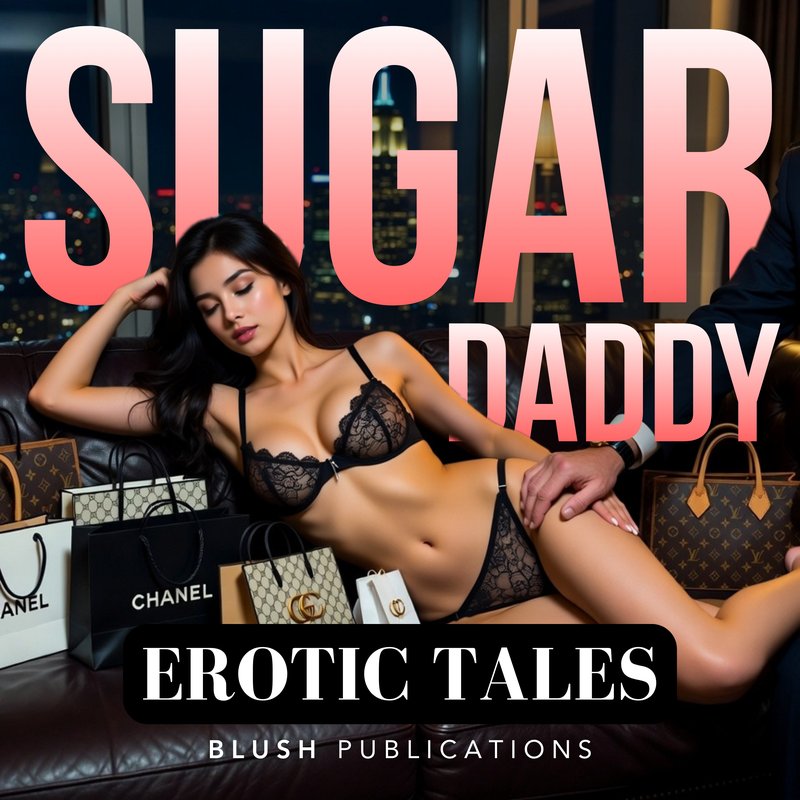
Sugar Daddy Erotic Tales collects the trope in short form, which suits it — each story gets to set up its own arrangement and break it, rather than stretching one deal across four hours. The sugar daddy category has the rest, and the neighbouring older man and daddy shelves cover the adjacent dynamics if it turns out the arrangement was not the part you wanted.
Every book page has a free audio sample, which is the fastest way to check whether a narrator plays the offer as warmth or as leverage — those two readings produce very different books from identical text.
Frequently Asked Questions
Is sugar daddy romance always age gap?
Overwhelmingly but not necessarily. The trope needs someone with resources, and resources tend to accumulate with age. The defining element is the arrangement, not the birthdays.
Are the characters adults?
Yes, without exception — every character in this genre is eighteen or over. The subgenre is explicitly about adults negotiating with each other.
Is it the same as escort or exchange romance?
Related but distinct. Escort stories are transactional per encounter; sugar daddy stories are relational and ongoing, with terms that cover time rather than acts. The difference matters to the plot, because ongoing arrangements can be renegotiated and single transactions cannot.
Does she always fall in love with him?
In the romance version, yes — that is the genre contract. In the erotica version the ending is more open, and plenty of stories end with the arrangement intact rather than dissolved into a relationship. Check which you are buying.
What should I read if I like the power dynamic but not the money?
Try boss and office erotica, where the leverage is professional rather than financial, or women in charge if you want the same asymmetry running the other direction.
Books Mentioned
Sugar Daddy Erotic Tales
Rich older men, kept women, and financial domination in 10 explicit sugar daddy erotica short stories.

Billionaire Erotic Tales
Ruthless moguls, penthouse encounters, and obsessive possession in 10 explicit billionaire erotica short stories.

Older Man Erotic Tales
Old enough to be her daddy. 30 explicit age-gap stories of experienced older men.